





Second of two parts
"NOT OFTEN do I disagree with your views, but on illegal aliens we are a world apart," writes V., one of many readers I heard from after suggesting last week that the best solution to our illegal immigration problem might be to make more immigration legal. "My view, unlike yours, is to secure the borders by whatever means possible. Arrest, imprison, and heavily fine employers who hire illegals. Apprehend and deport illegals no matter how long it takes -- years, if necessary.
"The American people," V. concludes, "overwhelmingly want these illegals out of the country."
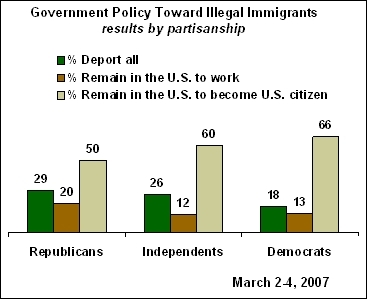
Actually, only about one American in four feels that way. According to a new Gallup poll, when asked to choose among three options -- deporting all illegal immigrants, allowing them to remain temporarily in the United States to work, or allowing them to stay permanently and become US citizens after meeting certain conditions -- a majority, 59 percent, chose permanent legalization. Fifteen percent favored the temporary-worker option. Just 24 percent supported deportation. Even when broken down by party loyalty, legalization remains the preferred course.
What the throw-'em-out school lacks in numbers it more than makes up for in vehemence, as anyone tuning in to the immigration debate soon discovers . But the raucous demand for ever-tougher border security tends to drown out a disconcerting fact: It doesn't work. The harder we make it for illegal immigrants to enter the country, the more unwilling they are to leave once they get here.
"Between 1986 and 2002 the number of Border Patrol officers tripled," notes Princeton sociologist Douglas Massey, an expert on Mexican migration, "and the number of hours they spent patrolling the borders . . . grew by a factor of about eight." As its budget exploded from $151 million to $1.6 billion, the Border Patrol became "the largest arms-bearing branch of the US government next to the military itself."
Yet driving up the risks and costs of crossing the border hasn't shrunk the number of illegal immigrants crossing the border -- only the number prepared to run that gauntlet more than once. Historically, Mexican migrants came to the United States sporadically, working for a while, then heading home. Now, millions figure it is better to stay put and risk deportation than to go back to Mexico and risk being unable to return. In 1986, the probability that an illegal entering from Mexico would leave within 12 months was around 45 percent. Today it is half that.
Nevertheless, suppose that V. and others got their wish, and 12 million illegal immigrants were forced out. What then?
As millions of farm hands, busboys, chambermaids, and garment workers vanished, who would take their places? Unemployed US citizens? With unemployment down to 4.5 percent, there aren't 12 million of them to spare. Even if there were, not many native-born Americans are prepared to accept the low wages and hard conditions that characterize so much illegal-immigrant labor.
Hard-liners insist that there are no "jobs Americans won't do" if the pay is right. Well, how much would an employer have to pay you to pick lettuce or clean hotel rooms for a living? A lot of jobs that pay, say, $8 an hour and are acceptable to a Mexican or Guatemalan alien with little education, few skills, and a fear of being deported would evaporate at the $16 an hour Americans would demand. With more expensive labor would come more reliance on machines instead of people, more outsourcing to cheaper labor markets, more closing of no-longer-profitable ventures. If illegal immigrants disappeared, countless jobs would disappear with them.
Pull 12 million low-skilled workers out of the economy, and the cost of everything from yardwork to restaurant meals would soar. Higher costs would mean lower profits and disposable income, less investment, weaker growth.
"Some 1.2 million illegals are believed to work in construction," Holman Jenkins wrote in the Wall Street Journal last June. "If the cost of home building goes up, demand goes down: Less wood is sold, fewer nails, fewer power tools, fewer pickup trucks. Contractors would make less profit; ergo, Harley-Davidson would sell fewer Road Kings with all the chrome and finery."
And the ripples wouldn't stop there. Without the affordable child care provided by legions of immigrant nannies, many working mothers would have to quit their jobs and stay home. As the baby boomers approached old age, millions of new elder-care positions -- jobs now filled disproportionately by immigrants -- would go begging, or become considerably more costly. Subtract 12 million illegals and you subtract as well the $7 billion a year they pay into Social Security, as well as the additional billions many of them pay in federal income taxes.
The United States creates more than 400,000 new low-skill jobs each year, a tremendous employment magnet for hundreds of thousands of foreign workers. But because US law authorizes only 5,000 visas annually for low-skilled immigrants, there is simply no lawful way for most of the workers we need to enter the country. So they enter unlawfully -- a wrongful act, perhaps, but hardly an evil one.
Immigration is good for America. So is respect for the law. Nothing forces us to choose between them. As long as there is work for them to do here, immigrants will keep crossing the border. Wouldn't we all be better off if we let them cross it legally?
(Jeff Jacoby is a columnist for The Boston Globe.)