





Second of two parts
(Read Part 1)
ON EARTH DAY last week, Consumer Reports offered some recommendations to motorists looking for ways to make "greener automotive choices." At the top of its list: "drive a more fuel-efficient car or SUV."
Consumer Reports wasn't the only one making that suggestion.
- In his Earth Day proclamation, President Obama advised Americans to "drive fuel-efficient cars" and stressed his own commitment "to increasing fuel economy standards" as part of a campaign to "reduce greenhouse gases" and "lessen our dependence on foreign oil." To underscore the point, US automakers were invited to exhibit fuel-efficient vehicles on the White House grounds.
- The editors of National Geographic, fielding questions online, heard from one reader troubled by the fact that "transportation is our largest consumer of oil and thus our largest emitter of carbon." Editor Dennis Dimick replied that "buying and driving cars that get better fuel efficiency can only help" in cutting US fuel consumption, along with "driving less and using mass transit more."
- At the Huffington Post website, prolific commenter Philip Taylor listed what he called "the equations of conservation," including this one: Autos [Get] 40-65 MPG = Oil Demand Goes Way Down = Oil Prices Go Down.
- NASCAR announced that a Toyota Camry Hybrid would be the pace car for the Coca-Cola 600 at Lowe's Motor Speedway next month. "I'd prefer a stock car, knowing how exciting it is to hear the engine roar," said driver Denny Hamlin, "but I think NASCAR drivers are embracing the green outlook of hybrids."
It seems intuitive: Increasing the fuel-efficiency of automobiles -- or anything else that runs on gas -- should lower the demand for oil. If one driver can cut his consumption of gasoline by switching to a higher-mileage vehicle, doesn't it stand to reason that getting millions of drivers to make the switch would sharply reduce the nation's appetite for oil?
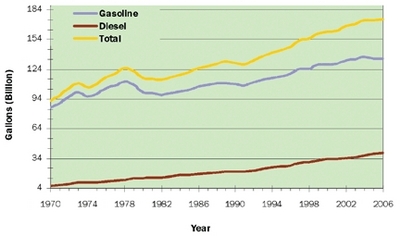 It was with precisely that expectation that Congress enacted the Corporate Average Fuel Economy (CAFE) standards in 1975, following the Arab oil embargo. At the time, US oil imports amounted to a little more than one-third of consumption. Today we import two-thirds. After more than three decades of CAFE standards, intensified environmental awareness, and steady improvements in fuel efficiency and engine technology, America's demand for oil is greater than ever. In 1975, highway fuel consumption amounted to 109 billion gallons, according to the Federal Highway Administration. By 2006 it had climbed to 175 billion.
"It seems obvious that rising efficiency in cars, furnaces, and lawn mowers should, in the aggregate, significantly curb demand for energy," write Peter Huber and Mark Mills in The Bottomless Well
Why? Because improvements in fuel economy are tantamount to making fuel less expensive, and when costs fall, demand tends to rise. As driving has grown cheaper in recent decades, people have done more of it -- choosing to drive to work instead of taking the bus, for example, or buying a second car, or moving to a house requiring a longer commute, or sending the kids to college with cars of their own. Between 1983 and 2001, data from the Energy Information Administration show, the annual amount of driving by the average American household rose from 16,800 vehicle-miles to more than 23,000.
"Efficiency may curtail demand in the short term, for the specific task at hand," Huber and Mills acknowledge. "But its long-term impact is just the opposite. When steam-powered plants, jet turbines, car engines, light bulbs, electric motors, air conditioners, and computers were much less efficient than today, they also consumed much less energy. The more efficient they grew, the more of them we built, and the more we used them -- and the more energy they consumed over all."
This counterintuitive phenomenon -- greater efficiency leads to greater consumption -- is sometimes called the Jevons Paradox, after the 19th-century mathematician who first articulated it. In his 1865 book, The Coal Question, Jevons explained that more efficient use of coal would increase -- not decrease -- the demand for coal. "It is a confusion of ideas to suppose that the economical use of fuel is equivalent to a diminished consumption," he wrote. "The very contrary is the truth."
Does this mean you shouldn't drive a more fuel-efficient automobile? Not at all: If you crave better mileage or you want to make an environmental statement or you think a hybrid can save you money, by all means get a more efficient car. Just don't expect to see fuel consumption decrease. New technology is often wondrous, but that's one miracle it can't perform.
(Jeff Jacoby is a columnist for The Boston Globe).
-- ## --
Follow Jeff Jacoby on X (aka Twitter).
Discuss his columns on Facebook.
Want to read more? Sign up for "Arguable," Jeff Jacoby's free weekly email newsletter.