





First of two columns
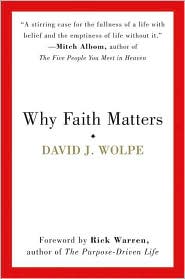
AT THE AGE of 12, David Wolpe lost his religious faith. Shaken by a film on the aftermath of the Nazi atrocities, he concluded there could be no God in a world that harbored such evil. His efforts to understand a godless universe led him, in time, to Bertrand Russell's biting essays against religion, which he keenly read and reread.
 That is what he was doing one day at the Jewish summer camp he attended as a teen, when one of the staff rabbis strolled by and asked what he was reading. To Wolpe's defiant answer -- "Bertrand Russell" -- the rabbi made a surprising reply: "Good." Startled, Wolpe asked what he meant.
"David, how old are you?" the rabbi asked in return.
"Seventeen."
"Well, I'd rather have you grow out of him than grow into him."
Grow out of him he did, and one result of that growth is Why Faith Matters
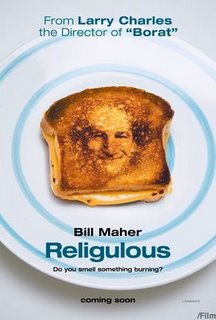
It is interesting to experience, in the same week, both Wolpe's book and Religulous, Bill Maher's cinematic assault on organized religion. Maher, a caustic comedian and TV host, also turned his back on religion in his teens. "I hated church; it scared me," he says near the start of Religulous. He also says, somewhat inconsistently, that he found religion "boring" and that it "wasn't relevant" to his life.
Like Wolpe's book, Maher's movie raises questions about faith; unlike Wolpe, Maher isn't interested in answers. Religulous is a profane, condescending, and often funny rant against religion -- Christianity especially, but also Judaism, Mormonism, and Islam. Maher's mocking documentary promotes the idea that only oddballs, cranks, and nincompoops can take religion seriously. That's a fairly easy case to make if you focus, as Maher's interviews mostly do, on oddballs, cranks, and nincompoops: the Puerto Rican cult leader who claims to be the Antichrist, the pothead in Amsterdam with his marijuana "ministry," the misfit rabbi who embraces Mahmoud Ahmadinejad, the young-earth creationist who teaches that human beings and dinosaurs co-existed.
It's also easy to portray faith as a goofy fairy tale if you spend your time deriding tales of ancient miracles -- a burning bush! A virgin birth! A prophet swallowed by a fish! -- but never pause to acknowledge the far-fetched improbabilities inherent in atheism.
 Maher characterizes religion as "fantasy and nonsense." Yet atheism is no guarantee of enlightened rationality. In a study released this past September, researchers at Baylor University found that adherence to "traditional . . . religion greatly decreases credulity, as measured by beliefs in such things as dreams, Bigfoot, UFOs, haunted houses, communicating with the dead, and astrology." By contrast, those who reject traditional religion -- "self-identified theological liberals and the irreligious" -- are "far more likely" to believe in superstition and the occult. Or other nonsense: Maher, for example, claims that aspirin is lethal, doubts that the Salk vaccine eradicated polio, and has praised the horse that threw Christopher Reeve.
So it is unsurprising that Maher sees only the foolishness and evil that religious people, like all people, are capable of, and misses entirely the extraordinary good that religion engenders. As Wolpe notes, numerous researchers have found that "religious people are happier, more charitable, have more stable families, and contribute more to their communities." They are less likely to suffer depression or commit suicide, to use drugs or be involved with crime, to drink to excess, or to smoke.
The Los Angeles Times reported last year on research showing that people without faith were less likely to help a poor or homeless person than religious believers. While both were equally likely to describe themselves as "good citizens," their charitable practices were strikingly different. Americans of no faith donated an annual average of $200 to charity; active-faith adults typically contributed $1,500. Even when church-based giving was subtracted from the mix, religious Americans donated twice as much to charity as the nonreligious.
It is no coincidence that so many hospitals, schools, homeless shelters, and aid organizations have been started and sustained by religious groups. "We are creatures designed to flourish -- to heal and to help -- when we believe," Wolpe writes. Religion makes the world better, notwithstanding all the ways in which it has been perverted. A world without God and faith would be hellish and lonely. Perhaps it is also no coincidence that Why Faith Matters ends with the word "love," while the final word in Maher's film is "die."
Jeff Jacoby is a columnist for The Boston Globe.
-- ## --
Follow Jeff Jacoby on X (aka Twitter).
Discuss his columns on Facebook.
Want to read something different? Sign up for "Arguable," Jeff Jacoby's free weekly newsletter.