





THOUGH IT HASN'T BEEN TRUE for years, many people believe that government employees receive such lavish employment and retirement benefits in order to compensate for their meager paychecks. The reality is that their paychecks aren't meager at all: Government jobs pay more than those in the private sector, and the difference between the two is growing.
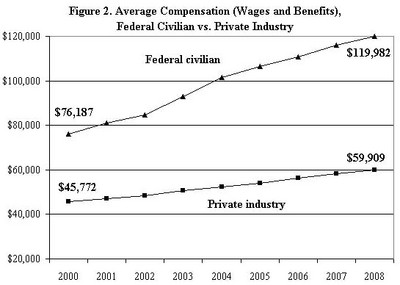 Consider the lucrative lot of the men and women who work for Uncle Sam. In 2008, according to data from the Commerce Department's Bureau of Economic Analysis, the 1.9 million civilian employees of the federal government earned an average salary of $79,197. The average private employee, by contrast, earned just $49,935. The difference between them came to more than $29,000 -- a differential that has more than doubled since 2000.
Take account of total compensation -- wages plus benefits -- and the disparity is even more striking. In 2008, total federal civilian compensation averaged $119,982 -- more than twice the $59,908 in wages and benefits earned by the average private-sector employee. Chris Edwards, a scholar at the Cato Institute, has documented the steady widening of the gap: In 1960, federal workers averaged $1.24 for every $1 earned by a private employee. By 1980, the federal advantage was up to $1.51; in 2000 it was $1.66. Now it is $2 -- and climbing. When ranked alongside 72 industries that span the US economy, federal employees take home the seventh-highest average compensation. Among the workers they outearn, Edwards shows, are those in such fields as computer systems design, chemical products, and legal services.
It isn't only at the federal level that the political class so handsomely takes care of its own. "State and local government workers get paid an average of $25.30 an hour, which is 33 percent higher that the private sector's $19," Forbes magazine reports. "Throw in pensions and other benefits and the gap widens to 42 percent." The Tax Foundation calculates that "non-wage compensation" for the average state and local government employee worked out to $12,362 in 2007. For the average employee in the private sector, the comparable figure was just $8,784.
Americans increasingly fall into one of two camps. Those who work for the government -- about 15 percent of the labor force -- tend to enjoy sumptuous perks, virtually indestructible job security, early retirement, and pensions that are guaranteed for life. The rest of us -- the vast majority -- work in the private economy, where millions of jobs can be wiped out by a recession, where defined-benefit pensions are disappearing, and where competition and downsizing are harsh facts of life.
 This is not to deny that particular government jobs may be underpaid when compared with private markets, nor to suggest that many public workers are not diligent and hardworking. All the same, a backlash is coming, and it gets closer with each new revelation of public employees enriching themselves at taxpayer expense. Employees like the double-dipping Florida college president who took a lump sum "retirement" benefit of $893,286 and receives a $14,631/month pension, yet continues to collect an annual salary of $441,538. Or like the former Massachusetts lawmakers who qualified for tens of thousands of dollars in enhanced pensions -- many while still in their 40s -- merely by resigning from the legislature. Or like the Buffalo, N.Y., police detective who is serving a 45-year sentence for setting up drug raids in order to steal money and jewelry, but still receives an annual pension of more than $40,000.
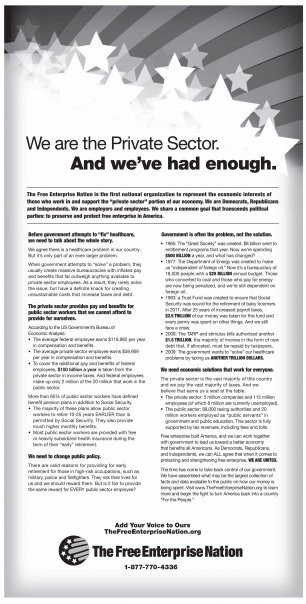
A full-page ad in The Wall Street Journal last week was the clearest evidence yet of the approaching showdown. "We are the Private Sector. And we've had enough," the ad proclaimed. It announced the launch of The Free Enterprise Nation, which describes itself as the first national organization intended to represent the interests of the majority of Americans who work in the private economy. Its message was blunt: "The private sector provides pay and benefits for public sector workers that we cannot afford to provide for ourselves. . . . We need to change public policy."
The Free Enterprise Nation -- online at TheFreeEnterpriseNation.org -- is headed by James MacDougald, a successful Florida businessman who has invested more than $1 million in the organization. Already he has assembled a staff of 65, including 10 researchers. He foresees the day when the group will be as influential as the AFL-CIO, and when government officials never make a move without considering its impact on the private sector.
"We're going to generate enough noise that government can't ignore us," he told me yesterday. "We aren't going away." Stay tuned.
(Jeff Jacoby is a columnist for The Boston Globe.)