





NOT ALL DEATHS ARE SAD. The federal estate tax died at 12:01 A.M. on January 1, an occasion of joy if there ever was one. Allowing it to expire was one of the few sensible things Congress accomplished in 2009. Keeping it dead should be a congressional goal for 2010.
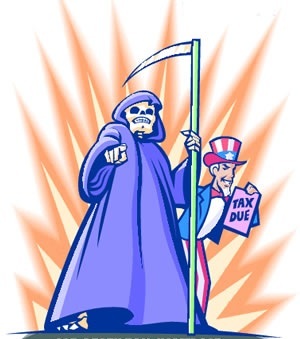 Estate-tax repeal was one element of the tax cuts George W. Bush signed into law in his first year as president. But the legislation was perversely drafted. It phased out the tax over 10 years, reducing the rate from 55 percent in 2001 to 45 percent in 2009, and then eliminating it entirely in 2010 – but only for a year. If Congress does nothing else, the estate tax will reappear in 2011, at the old rate of 55 percent on all assets above $1 million.
Needless to say, this temporary vanishing act is wreaking havoc on estate planning, and many analysts expect lawmakers to revive the tax sometime this year, perhaps even making it retroactive to January 1. But if the goal is clarity and certainty in the tax code, a far better option would be to make the repeal permanent.
To class warriors, of course, abolition of the estate tax is a disgrace. The American Prospect's Tim Fernholz wonders why foes of the estate tax are so keen on "lining the pockets of the already-wealthy," and bristles at the thought of not taxing "folks who inherit huge fortunes" when their parents die. "It makes little sense," declaims USA Today in a recent editorial, "to shower tax breaks on a tiny sliver of the nation's wealthiest citizens."
But the nation's wealthiest citizens aren't the ones the estate tax hurts. The Rockefeller, Buffett, and Kennedy fortunes are secure, shielded from the IRS by flocks of tax lawyers and accountants. As Henry J. Aaron of the Brookings Institution and Boston College economist Alicia Munnell have sardonically observed, estate taxes "are penalties on those who neglect to plan ahead or who retain unskilled estate planners." Populist rhetoric notwithstanding, they add, American estate taxes "have failed to achieve their intended purposes. They raise little revenue. They impose large excess burdens. They are unfair."
Far from affecting only billionaires and pampered heiresses -- inheritance tax supporters love to invoke Paris Hilton -- taxes on estates are mostly levied on small- to medium-sized businesses and family-owned farms. Between 1995 and 2004, the congressional Joint Economic Committee noted in a 2006 report, estate taxes were paid by the owners of more than 37,000 "closely-held businesses," as well as 24,000 farms, 50,000 limited partnerships, and nearly 28,000 other non-corporate businesses. "These data clearly indicate," said the JEC, "that the estate tax has broad and significant costs for thousands of family businesses."
Since many such businesses operate without large cash reserves, a hefty tax bill can leave them with no option but to liquidate valuable assets or sell off the business entirely. The cumulative cost to the economy can be measured in lower growth, lost jobs, and diminished entrepreneurship. According to a 2009 study by Douglas Holtz-Eakin, the former director of the Congressional Budget Office, permanent abolition of the estate "would raise the probability of hiring by 8.6 percent, increase payrolls by 2.6 percent, and expand investment by 3 percent. . . . [T]his translates to roughly 1.5 million additional small business jobs." It also translates to higher federal revenues -- not the first time a tax cut would yield an increase in tax dollars collected.
But while the practical and economic arguments against the estate tax are many and strong, it is the moral argument that really hits home.
The estate tax is pernicious because it punishes precisely the kind of behavior society should want to reward -- work, prudence, savings -- and it rewards behavior that should be discouraged -- profligacy, overconsumption, and leisure. The easiest way to avoid all death taxes, after all, is to spend your money before you go. Work hard, reinvest your earnings, and leave your life's savings to your loved ones, on the other hand, and the IRS becomes one of your heirs. As economist Arthur Laffer memorably put it in an essay last year, "Spend It in Vegas, or Die Paying Taxes." That is hardly the message we should want our tax laws to convey.
(Jeff Jacoby is a columnist for The Boston Globe.)
-- ## --