





LAST WEEK'S VOTE by the Massachusetts Board of Higher Education to establish a state-run law school didn't come close to passing the smell test.
 The vote authorized the University of Massachusetts at Dartmouth to acquire the Southern New England School of Law, a small private institution that had offered to donate itself to the state. Massachusetts Education Secretary Paul Reville called the offer "an extraordinary gift" that for the first time would enable UMass to provide "an affordable, high-quality legal education," all without costing the taxpayers a dime.
In some alternate universe, maybe. In this one, however, the merger will almost certainly cost Massachusetts taxpayers a small fortune.
Southern New England is nobody's idea of a first- or even second-rate law school. It has twice been denied accreditation by the American Bar Association. Its admission standards are derisory. Its library is inadequate. Its faculty is modest in both size and reputation. Not surprisingly, a large majority of its graduates fail the Massachusetts bar exam.
 UMass officials claim that the school can be transformed into something far better at no public cost, but their plan for achieving that goal is dubious. It calls for sharply increasingly enrollment from 235 to 559, dramatically upgrading academic standards, yet charging less than $24,000 in tuition and fees -- 35 percent less than the average per-student expenditure of other public law schools in the Northeast. To pull off such a feat, estimates James White, who for 26 years was the ABA's chief consultant on legal education, would require a subsidy of between $92 million and $110 million over the next 10 years. The Pioneer Institute concurs, rating the UMass plan "virtually impossible."
"Their financials simply don't work," John O'Brien, a former chair of the ABA's Accreditation Committee, told the Boston Globe. "This will bite the taxpayers and bite them big." The rosy scenario laid out by UMass-Dartmouth, he said, "is fiction." It is hard to see how any reasonable observer could disagree.
But because O'Brien is also the dean of the New England School of Law, one of three smaller private law schools strenuously opposed to the UMass takeover of Southern New England -- the others were Suffolk University and Western New England School of Law in Springfield -- his warning was ignored. Worse than that: He and his counterparts at the other law schools were accused of basely conspiring to crush an innocent competitor.
UMass trustee James Karam, for example, ominously wondered "whether Suffolk and New England are in collusion . . . to try to stop an affordable alternative for a legal education in this state." Jack Wilson, the president of the University of Massachusetts system, labeled the private law schools' objections "nothing short of shameful." One newspaper commentary charged the schools with having "joined in a holy battle to . . . snuff out a weaker competitor."
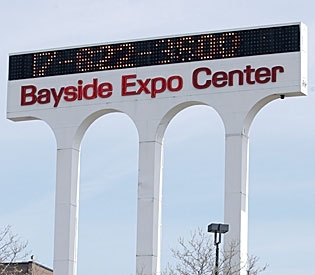 Unable to compete with a heavily subsidized state-owned rival, the Bayside -- long home to some of New England's most popular gate shows -- is going out of business. |
A more recent victim of Beacon Hill's edifice complex is the Bayside Expo Center, the privately-owned Dorchester venue that for years hosted Boston's most popular gate shows, including the New England Boat Show and the International Auto Show. The Bayside's death warrant was signed when the state decided to build its own gigantic convention center in South Boston. Unlike the government-run Boston Convention & Exhibition Center, the Bayside's losses aren't covered by annual taxpayer subsidies. So the biggest gate shows in Boston now go to the BCEC, and the Bayside will go out of business in the spring.
With a higher density of lawyers than all but three other states, Massachusetts doesn't need a government-run law school any more than it needs government-run supermarkets. But need isn't what drives empires to expand. UMass-Dartmouth's acquisition of Southern New England will no doubt cost Massachusetts taxpayers millions of dollars they cannot afford. It may cost the state's smaller private law schools more than just money.
(Jeff Jacoby is a columnist for The Boston Globe).
-- ## --